
Issue 01 Your Storeroom Is Talking. Are You Listening?
The NCS Review
Season 1: Seeing What Others Miss
Issue 001
Your Storeroom Is Talking. Are You Listening?
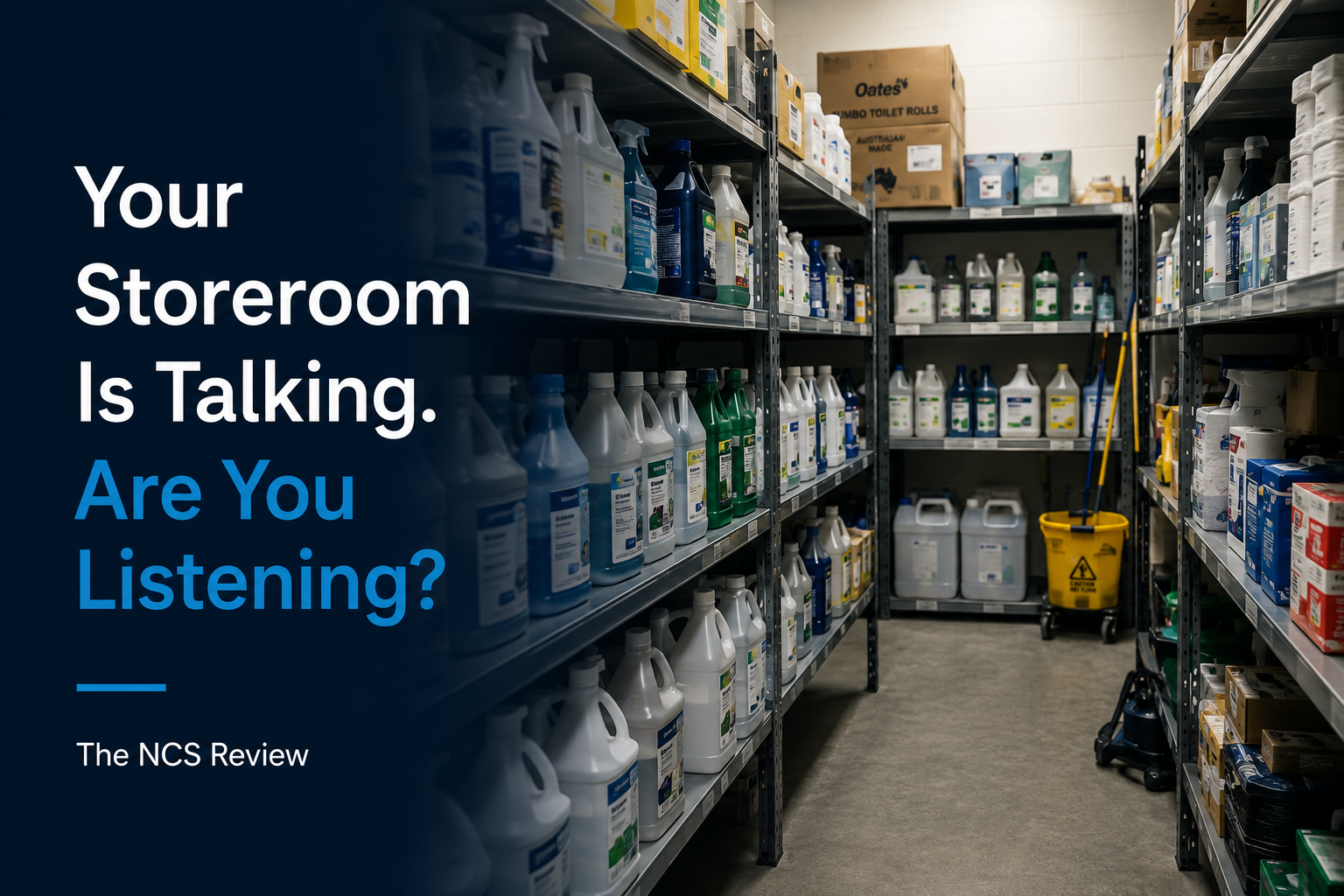
"One of the first places we like to visit when arriving on site isn't the reception area, the offices or even the cleaning cupboard. It's the storeroom."
It often surprises people.
When most people think about improving the performance of a business, they think about sales, staffing, marketing or technology. Rarely does anyone suggest looking at the shelves where paper products, chemicals, consumables and equipment are stored.
Yet after visiting hundreds of commercial workplaces over the years, we've found that a storeroom is often one of the most honest reflections of how an operation really functions.
It doesn't tell us everything.
But it tells us far more than most people realise.
Within minutes, a storeroom begins telling a story.
Not through words, but through patterns.
The way products are organised.
The quantity of stock being held.
The condition of equipment.
The number of similar products performing the same task.
The products that are covered in dust.
The shelves that are overflowing.
The empty spaces where critical items should be.
The handwritten labels.
The old cartons tucked away in corners.
None of these things are necessarily problems on their own.
Together, however, they begin to paint a picture.
Every Storeroom Tells a Story
We've walked through storerooms in wineries preparing for vintage, childcare centres preparing for the return of students, healthcare facilities operating around strict compliance requirements, commercial kitchens working under relentless time pressure, industrial workshops, offices, sporting facilities and countless commercial buildings.
Every workplace is different.
Every team works differently.
Every operation has its own priorities.
Yet the stories often sound remarkably familiar.
"We've always used that product."
"I think that's still in use."
"I didn't even know we stocked those."
"That machine needs repairing."
"We ordered more because we couldn't find any."
"We keep that one just in case."
They're comments we've heard countless times.
They're also reminders that operational inefficiencies rarely appear overnight.
They accumulate slowly.
One small purchasing decision.
One supplier change.
One staff member leaving.
One temporary solution that quietly becomes permanent.
Over months and years, those small decisions compound until complexity becomes normal.
Eventually nobody notices it anymore.
The Cost of Complexity
One of the biggest misconceptions we encounter is that operational cost is driven primarily by purchase price.
In reality, purchase price is only one part of the equation.
A product that costs less but requires twice as much to achieve the same result is rarely cheaper.
A chemical that isn't consistently diluted increases consumption.
Multiple products designed for the same purpose create confusion.
Equipment that isn't maintained becomes unreliable.
Poor storage increases waste.
Excess stock ties up cash.
Missing stock creates downtime.
Every one of these things costs money.
The challenge is that very few of those costs appear on an invoice.
Instead, they appear as wasted time.
Repeated work.
Training inconsistency.
Staff frustration.
Emergency purchases.
Unnecessary stockholding.
Lost productivity.
These are operational costs.
They're far harder to measure than the price printed on a carton, yet they're often far more significant.
Simplicity Is Often the Greatest Improvement
One of the most consistent observations we've made over the years is that high-performing operations are rarely the ones with the most products.
They're usually the ones with the fewest.
Not because they cut corners.
Because they simplify.
Their teams know exactly which product to use.
Their equipment is maintained.
Stock levels are understood.
Ordering becomes predictable.
Training becomes easier.
New staff become productive more quickly.
The storeroom supports the operation rather than complicating it.
That simplicity isn't accidental.
It's designed.
What We Look For
People occasionally ask what we're actually looking for when we walk into a storeroom.
The answer is surprisingly simple.
We're not conducting an audit looking for mistakes.
We're looking for opportunities.
Could two products become one?
Are staff using the right products consistently?
Is stock easy to locate?
Is equipment ready for use?
Are expensive products being used where a simpler solution would work just as well?
Has purchasing drifted over time?
Would someone unfamiliar with the business understand how the storeroom works?
Sometimes the answers lead to significant changes.
Sometimes they confirm that everything is working well.
Both outcomes are valuable.
Looking Beyond Cleaning Products
Although cleaning products often fill the shelves, this isn't really a story about cleaning.
It's a story about operations.
Storerooms are where procurement, inventory management, training, maintenance, planning and daily routines all come together.
That's why they're such powerful indicators of operational health.
When those systems work together, the storeroom feels calm.
Products are where they should be.
Staff know what they're looking for.
Stock moves predictably.
Nothing feels accidental.
When those systems aren't aligned, the storeroom usually reflects it long before the financial reports do.
The Conversation Your Storeroom Is Already Having
Whether we realise it or not, every storeroom communicates something about the way a business operates.
It tells a story about purchasing decisions.
About leadership.
About planning.
About consistency.
About culture.
The question isn't whether your storeroom is communicating.
It already is.
The real question is whether anyone is listening.
A Question Worth Asking
If someone walked into your storeroom today with no prior knowledge of your business, what conclusions would they draw?
Would they see clarity?
Consistency?
Efficiency?
Or would they see years of small decisions that have quietly made everyday work more complicated than it needs to be?
Sometimes the most valuable operational insights aren't hidden in reports or dashboards.
Sometimes they're sitting quietly on a shelf, waiting for someone to notice them.
The NCS Review
Helping businesses see what others miss.